How This
Was Made
DELIRIUM is a fictional gallery, but nothing on it is faked. Every work is a real generative system, computed live in your GPU. This page explains exactly how it was built — by an AI agent, autonomously, in one session — so you could commission the same thing.
01The Concept
The brief: a digital art gallery where the art is code. The design answer was a white-cube gallery
inverted — near-black walls (#060606) so the shader works glow like lightboxes, museum placard
typography (title, medium, year, edition), and a curatorial voice that treats fragment shaders the way
wall text treats oil paint. The iridescent teal–magenta–gold palette is a single cosine gradient function,
oil(t), shared by every work, which is what makes six different algorithms read as one artist.
02The Actual Techniques
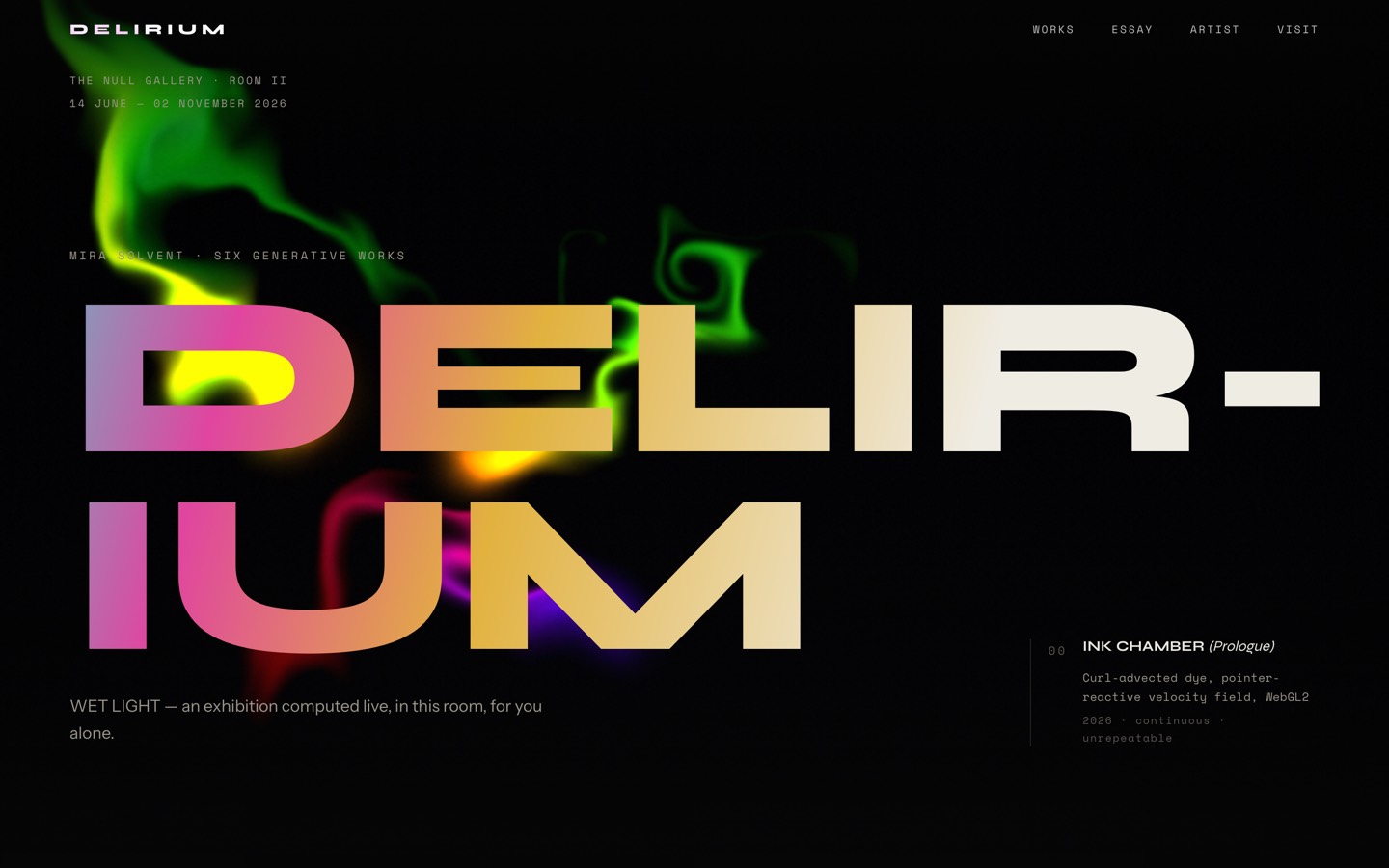
- Hero — Ink Chamber. Raw WebGL2, no libraries. A ping-pong framebuffer holds a dye field; each frame a shader advects it along the curl of fbm noise, plus a gaussian velocity splat under the pointer. When idle, a scripted "phantom hand" keeps the ink moving.
- Seep. Gray–Scott reaction–diffusion in an
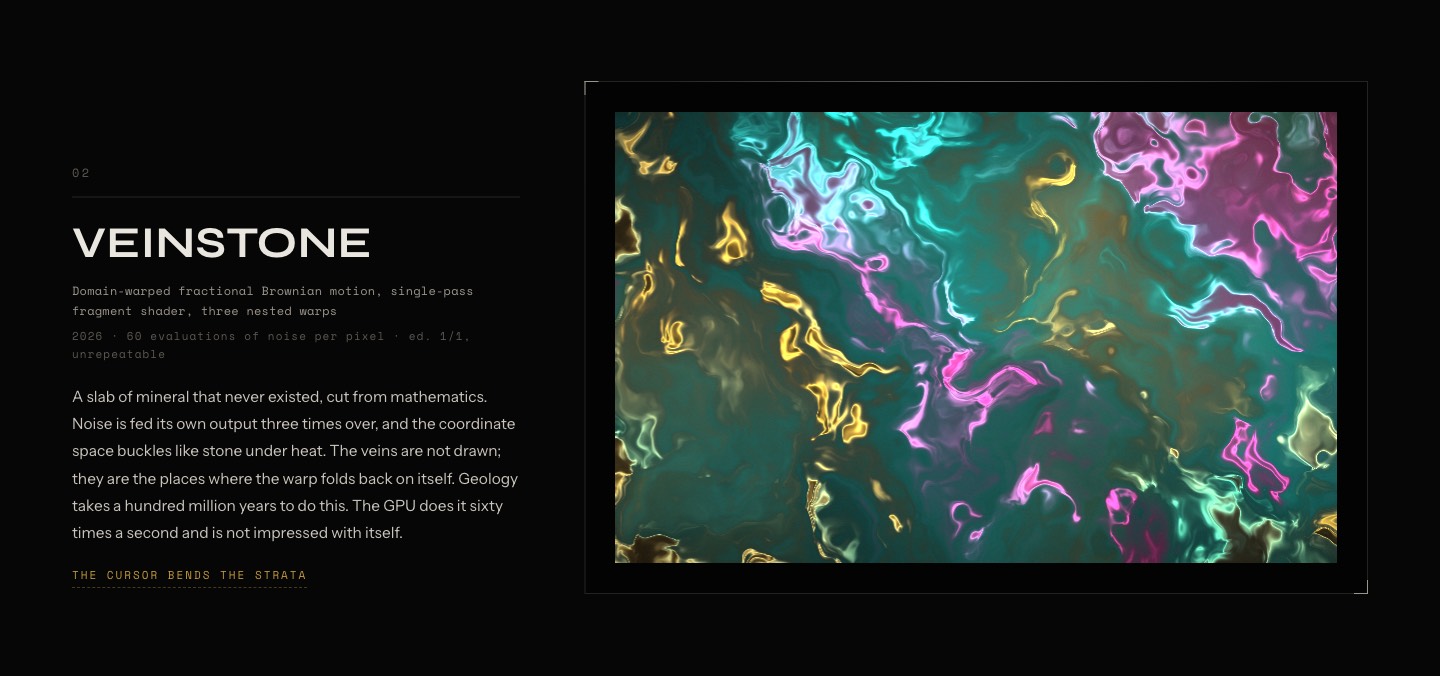
RGBA16Fping-pong buffer, ten simulation steps per frame, feed/kill rates drifting on slow sine waves. Hovering injects chemical B. - Veinstone. Ivan Quilez–style domain warping:
fbm(p + 4·fbm(p + 4·fbm(p))), veins extracted where the warp folds, cursor repels the coordinate space. - Coalesce. Eight inverse-square metaball potentials plus the pointer as a ninth; the skin
is shaded with
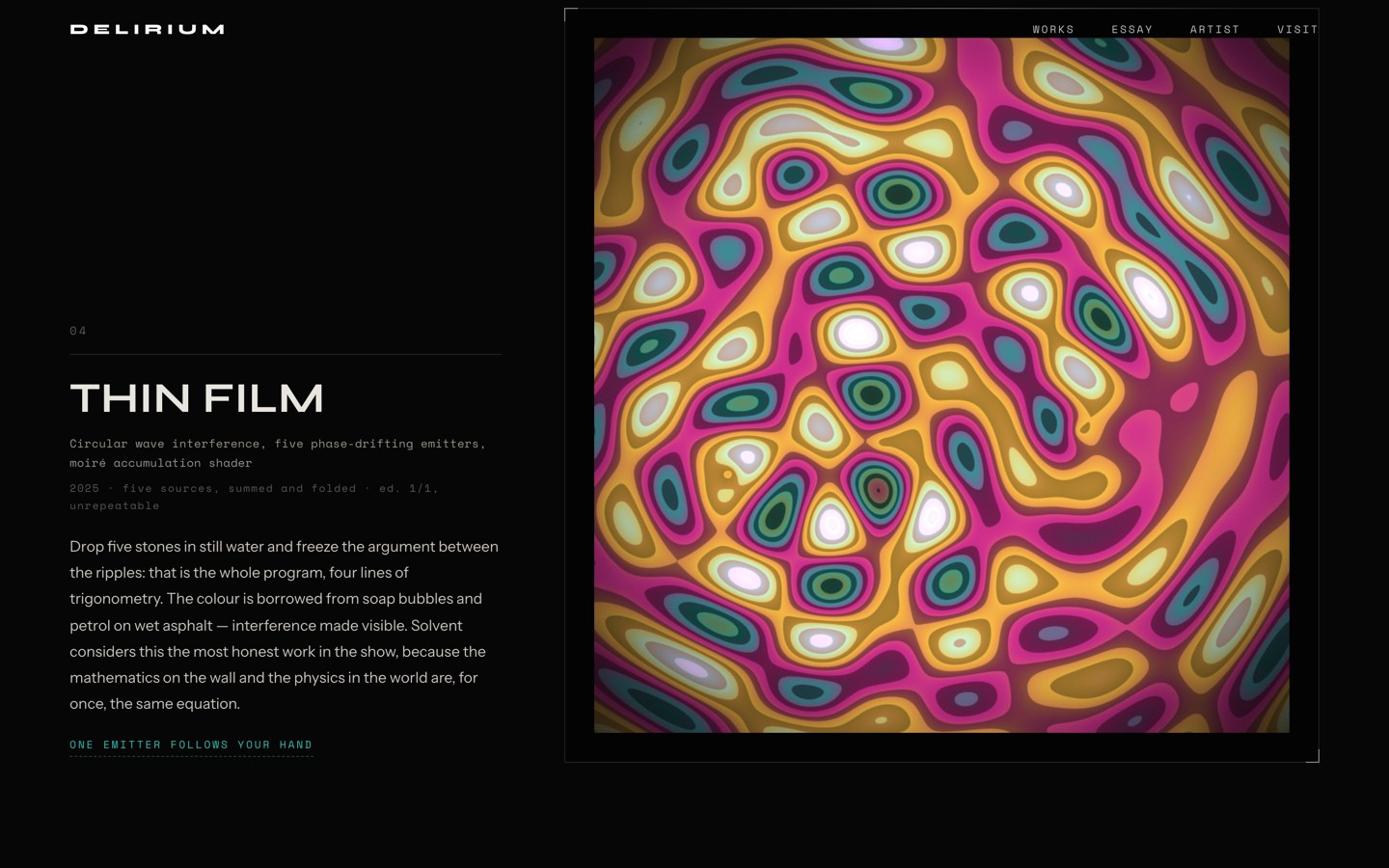
fwidth-antialiased iso-contour fringes. - Thin Film. Five drifting emitters, summed sine waves by distance — literal interference — with one emitter handed to the cursor.
- Ghost Orbit. The one non-shader piece: a de Jong attractor plotting 12,000 states per frame
on a 2D canvas with additive
lightercompositing and a slow fade.
Everything lazy-initializes via IntersectionObserver and pauses off-screen. Fonts are Syne and
Instrument Sans from fonts.bunny.net. prefers-reduced-motion visitors get warmed-up still frames
instead of animation. Total stack: HTML, CSS, one vanilla JS file. Zero dependencies, zero build step, zero images.
03Three Passes
The build ran a strict loop: serve locally, screenshot at desktop and 390px mobile widths, read the screenshots, list at least five concrete flaws, fix them, repeat.
04How to Prompt This
If you want an AI agent to build something like DELIRIUM, the trick is to commission the systems, not the pictures. A working prompt:
The last sentence is the one that matters.